Energy Concept
The integrated energy concept combines local energy sources, innovative storage technologies and modern supply systems to form a smart, interconnected system.

The EUREF-Campus Düsseldorf embodies a forward-looking approach to energy supply. At the heart of the development is a state-of-the-art energy centre which, together with photovoltaic systems, heat pump technology and innovative storage solutions, forms a smart energy concept. Even before it was commissioned, the campus was regarded as a flagship project for the intelligent integration of modern energy and building technologies. Together, EUREF, Stadtwerke Düsseldorf and BLS Energieplan have developed a supply concept that harnesses local energy potential and intelligently links various energy sources. At the EUREF-Campus, the energy supply of the future comes to life.

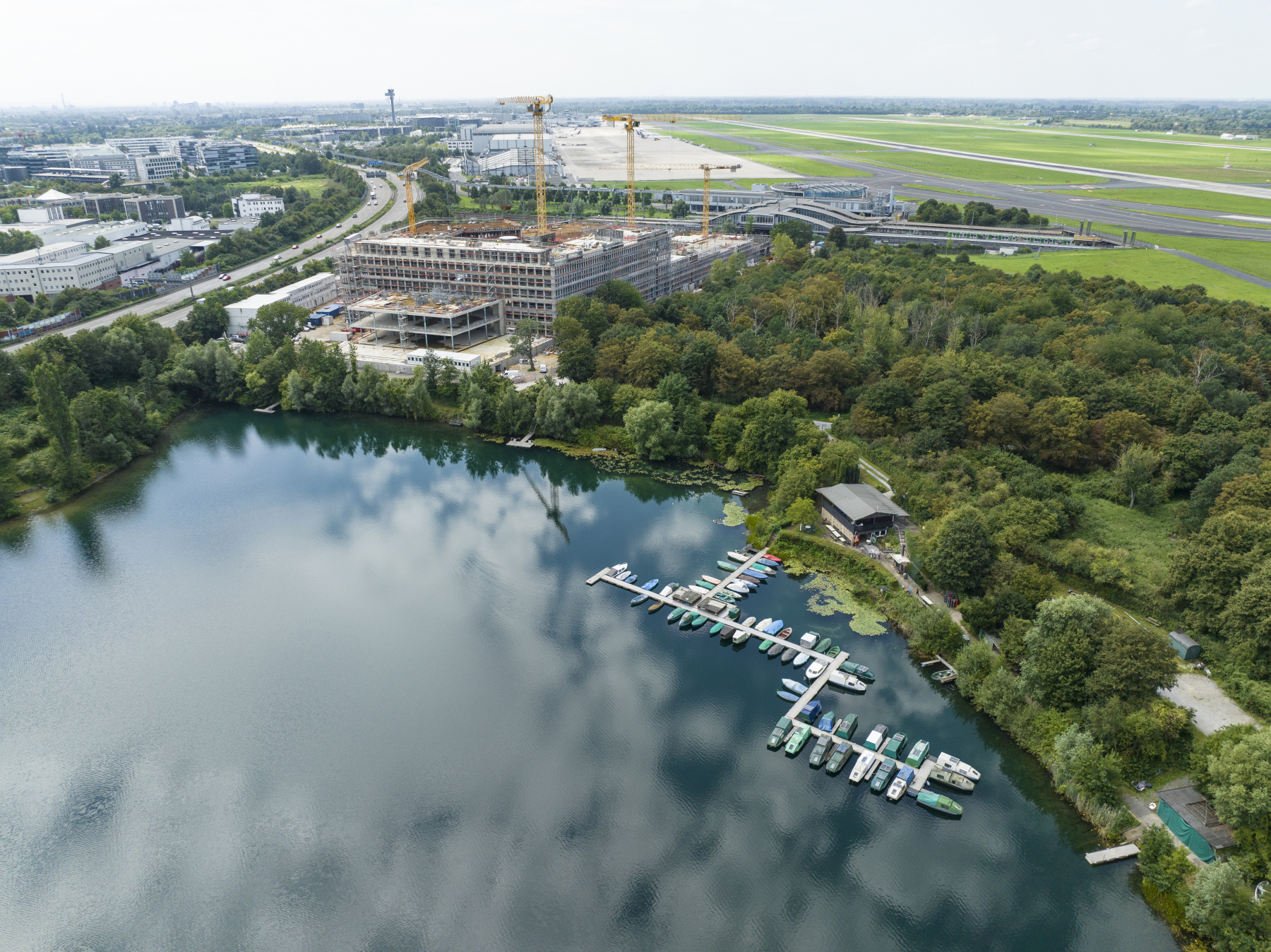
The integrated energy concept combines local energy sources, innovative storage technologies and modern supply systems to form a smart, interconnected system.
A key contribution to this is made by the thermal utilisation of the Lichtenbroich quarry lake. In conjunction with highly efficient heat pumps, the energy stored there is used to heat the buildings in winter and cool them in summer. The system is supplemented by photovoltaic installations on the campus roofs, which provide electricity for the campus’s own consumption. Ambient air is also used to cool the buildings, whilst district heating from Stadtwerke Düsseldorf ensures a secure supply on particularly cold days.
The result is an innovative combination of state-of-the-art energy technologies, making the EUREF-Campus an attractive location for companies wishing to combine innovation, networking and future-oriented infrastructure.
The proximity to the Lichtenbroich quarry lake enables the use of lake water. The lake water station is a key component of the energy concept. Here, two pipes are fed into the lake: one into the upper water layers and one into the lower water layers. Water flows through a strainer from the lake water station into a heat exchanger, which heats the lake water in summer and cools it in winter. The water then flows back into the lake with a temperature difference of approximately 2–5°C (warmer or colder), biologically and chemically unchanged and therefore safe.
In this process, the quarry lake acts as a heat source in winter and as a heat sink in summer. The water on the secondary side, which is heated or cooled by the lake, is then temporarily stored in a source storage tank and is subsequently used either to directly regulate the temperature of the building or as a source for the highly efficient heat pumps. The concept is complemented by an intelligent energy management system from Schneider Electric – the Microgrid Advisor. This links all energy generators – lake water, heat pumps, solar energy, hybrid cooler, district heating, energy storage and charging infrastructure – to form an integrated energy infrastructure.
Cooperation partner